The Fire of Yahweh
The prophet Ezekiel saw Yahweh in a chariot of fire and cherubim.
"The glory of Yahweh filled the temple. The glory of Yahweh appeared to all the people, and a fire came forth from before Yahweh and consumed the burnt offering." – What on earth happened at the temple in Jerusalem?
One of the most important elements of the Yahweh cult was the burnt offering. Every day the priests brought sacrifices of bull calves, lambs, doves or crops. It was commanded by Yahweh, conveyed by Moses and recorded in the books of Moses: ”… 'This is the law of the burnt offering: the burnt offering shall be on the hearth on the altar all night until the morning; and the fire of the altar shall be kept burning on it … it shall not go out.” [Leviticus 6:9-13].
After the Exodus from Egypt, the people gathered at Mount Sinai, where they had a covenant with Yahweh. Here Moses constructed a sanctuary for Yahweh, a "movable temple", called the Tent of Meeting. In front of it, he built a sacrificial altar.
When Moses had finished the Tent of Meeting, it was to be dedicated, and all the people were gathered to witness the ceremony. The priest Aaron ascended the altar and offered various animals. ”… and he came down from offering the sin offering, and the burnt offering, and the peace offerings. Moses and Aaron went into the Tent of Meeting, and came out, and blessed the people: and the glory of Yahweh appeared to all the people. There came forth fire from before Yahweh, and consumed the burnt offering and the fat upon the altar: and when all the people saw it, they shouted, and fell on their faces.” [Leviticus 9:22-24]. It was a powerful and convincing sign that the god Yahweh himself lit the sacrificial fire.
When King Solomon had the temple of Yahweh built on the mountain in Jerusalem several hundred years later, nearly the same thing happened because the temple also had to be dedicated. It started with the king saying a prayer. ”Now when Solomon had made an end of praying, the fire came down from heaven, and consumed the burnt offering and the sacrifices; and the glory of Yahweh filled the house. The priests could not enter into the house of Yahweh, because the glory of Yahweh filled Yahweh's house. All the children of Israel looked on, when the fire came down, and the glory of Yahweh was on the house; and they bowed themselves with their faces to the ground on the pavement, and worshiped, and gave thanks to Yahweh …” [2 Chronicles 7:1-3]. Here too, the fire miracle had a great effect on the people.
But the most amazing fire miracle was performed by the prophet Elijah when he challenged the prophets of Baal in a cultic contest on Mount Carmel. Elijah served in the northern kingdom of Israel during the time of King Ahab (ca. 875-852 BC).
The Bible says that King Ahab of Samaria was king over Israel for twenty-two years. He: ”… did that which was evil in the sight of Yahweh above all that were before him.” [1 Kings 16:30].
King Ahab had married a Phoenician princess, Jezebel. She led the king and the people into idolatrous corruption, and she exterminated almost all of Yahweh's prophets. [Kings 18:4].
But Elijah stepped forward before the king and urged him to arrange a test of strength between the prophets of Baal and Elijah's god Yahweh: ”… gather to me all Israel to Mount Carmel, and four hundred fifty of the prophets of Baal, and four hundred of the prophets of the Asherah, who eat at Jezebel's table.” [1 Kings 18:19].
On Mount Carmel, the people and all the prophets were now gathered for a "sacrificial contest" between Elijah and the many prophets of the other gods: ”Then Elijah said to the people, "I, even I only, am left a prophet of Yahweh; but Baal's prophets are four hundred fifty men. Let them therefore give us two bulls; and let them choose one bull for themselves, and cut it in pieces, and lay it on the wood, and put no fire under; and I will dress the other bull, and lay it on the wood, and put no fire under it. You call on the name of your god, and I will call on the name of Yahweh. The God who answers by fire, let him be God.' All the people answered, "It is well said.'” [1. Kong. 18:22-24].
First, the Baal prophets sacrificed their bull and arranged it on the altar, but without setting fire to it. All day long the prophets cried out to their god to set fire to the sacrifice, they danced and fell into ecstasy, but nothing happened.
Elijah mocked them, and in the evening he said to the people: ”… 'Come near to me;' and all the people came near to him. He repaired the altar of Yahweh that was thrown down … He made a trench around the altar … He put the wood in order, and cut the bull in pieces, and laid it on the wood. He said, 'Fill four jars with water, and pour it on the burnt offering, and on the wood.' He said, 'Do it a second time;' and they did it the second time. He said, 'Do it a third time;' and they did it the third time. The water ran around the altar; and he also filled the trench with water.” [1 Kings 18:30-35].
Then Elijah stepped forward and called upon Yahweh. ”Then the fire of Yahweh fell, and consumed the burnt offering, and the wood, and the stones, and the dust, and licked up the water that was in the trench.” [1 Kings 18:38].
A fire from Yahweh, which could burn sacrifice, stone, earth, and water, was a convincing miracle. Yahweh was God! The people then killed all the prophets of Baal.
For hundreds of years the fire burned on the sacrificial altar in front of Yahweh's temple in Jerusalem. In 598 BC, King Nebuchadnezzar captured Jerusalem, and he later razed the temple to the ground and carried off the elite of the people to Babylon.
But Nebuchadnezzar's dynasty had its time, after which it was overthrown by the Medes and Persians. The Judeans were allowed to return and rebuild the city and the temple.
The construction and dedication of the temple took place under the leadership of Nehemiah, the Judean governor of the Persian king, according to the late, apocryphal book Second Maccabees [2 Maccabees 1:18]. However, Nehemiah cannot possibly have participated in the construction and dedication, he did not come until several years later [Nehemiah 5:14], and he doesn't mention it himself either.
But the Book of Maccabees tells very vividly how the initiation took place: ”… when our fathers were about to be led into the land of Persia (not Persia but Babylonia, which was later taken over by the Persians cfk), the godly priests of that time took some of the fire of the altar, and hid it secretly in the hollow of a well that was without water, where they made sure that the place was unknown to anyone.” [2 Maccabees 1:19].
So before Nebuchadnezzar destroyed the temple, the sacrificial fire had been hidden in a well. ”It is also found in the records that Jeremiah the prophet commanded those who were carried away to take some of the fire, as has been mentioned …” [2 Maccabees 2:1].
The inaccuracies of the Book of Maccabees undeniably make the credibility of the narrative uncertain, although not necessarily completely wrong. But how could the sacrificial fire be hidden in a well for several generations, only to be found again?
The Book of Maccabees continues: ”Now after many years, when it pleased God, Nehemiah, having received a charge from the king of Persia, sent in quest of the fire the descendants of the priests who hid it. When they declared to us that they had found no fire, but thick liquid, he commanded them to draw some of it out and bring it to him. When the sacrifices had been offered, Nehemiah commanded the priests to sprinkle with that liquid both the wood and the things laid on it. When that was done and some time had passed, and the sun shone out, which before was hidden with clouds, a great blaze was kindled, so that all men marveled.” [2 Maccabees 1:20-22].
Nehemiah (or whoever it was) apparently knew the secret: ”… As soon as the sacrifice was consumed, then Nehemiah commanded that the rest of the liquid be poured on large stones. When this was done, a flame was kindled; but when the light from the altar shone back, it went out.” [2 Maccabees 1:31-32].
The Book of Maccabees tells: ”When the matter became known, and it was told the king of the Persians that, in the place where the priests who were led away had hid the fire, the liquid appeared which Nehemiah and those who were with him purified the sacrifice … Nehemiah and those who were with him called this thing “Nephthar”, which is by interpretation, “Cleansing”; but most men call it Nephthai.” [2 Maccabees 1:33-36]. It was highly probably inflammable rockoil, naphtha.[1]
Perhaps the oil was spiked with something that made it flammable, the sun's ultraviolet rays may have triggered a chemical reaction. Because: ”When that was done and some time had passed, and the sun shone out, which before was hidden with clouds, a great blaze was kindled …”
That was the secret behind the miracles where "Nehemiah", King Solomon and Moses let Yahweh's fire ignite the burnt offerings in front of the temple and the Tent of Meeting. And it was with a volatile oil that Elijah created the violent fire phenomenon on Mount Carmel.
King Solomon built the temple to Yahweh on the mountain in Jerusalem [1 Kings 5:15-6:38]. To the left of the temple's entrance, he placed "the sea". It was a gigantic bronze vessel, approximately 4.6 meters in diameter, filled with water. It rested on twelve oxen [1 Kings 7:23-26]. They probably symbolized the twelve tribes of Israel, the entire kingdom.
In addition, the king had ten chariots constructed of bronze with somewhat smaller water vessels on them: ”He made the ten bases of brass; four cubits was the length of one base (almost 2 meters cfk), and four cubits its breadth, and three cubits its height. The work of the bases was like this: they had panels; and there were panels between the ledges; and on the panels that were between the ledges were lions, oxen, and cherubim; and on the ledges there was a pedestal above; and beneath the lions and oxen were wreaths of hanging work. Every base had four bronze wheels, and axles of brass … the height of a wheel was a cubit and half a cubit. The work of the wheels was like the work of a chariot wheel … On the plates of its stays, and on its panels, he engraved cherubim, lions, and palm trees, according to the space of each, with wreaths all around. In this way, he made the ten bases: all of them had one casting, one measure, and one form. He made ten basins of brass: one basin contained forty baths (approximately 1500 liters cfk) and every basin was four cubits; and on every one of the ten bases one basin. He set the bases, five on the right side of the house, and five on the left side of the house: and he set the sea on the right side of the house eastward, toward the south.” [1 Kings 7:27-39].
The Chronicles tell that both the "sea of bronze" and the ten "temple chariots" with water vessels on them was made: ”… to wash in them; such things as belonged to the burnt offering …” [2 Chronicles 4:6]. See the book ’The King Mystery. Yahweh and the Daughter of Zion.’ for a closer understanding of the bronze chariots with water vessels.
After the death of King Solomon, the country was divided into the northern kingdom of Israel, which contained the ten tribes, and the southern kingdom of Judah, with only the tribe of Judah and the priestly tribe of Levi. Later, the northern kingdom of Israel was destroyed by the Assyrians and some of the people were taken away to Assyria. Only the Southern Kingdom remained.
In 586 BC, almost the same thing happened in Judah. The Babylonian king Nebuchadnezzar destroyed Jerusalem, and the temple was burned down. From Judah, the elite of the people, not least the priests, were sent into exile; they came to the land of the Chaldeans, to Babylon.
Here the priest and prophet Ezekiel had a vision: ”Now it happened in the thirtieth year, in the fourth month, in the fifth day of the month, as I was among the captives by the river Chebar, that the heavens were opened, and I saw visions of God. In the fifth day of the month, which was the fifth year of king Jehoiachin's captivity, the word of Yahweh came expressly to Ezekiel the priest, the son of Buzi, in the land of the Chaldeans by the river Chebar …” [Ezekiel 1:1-3]. At the tributary of the Chebar River, north of Babylon, Yahweh visited his people.
Ezekiel writes: ”I looked, and behold, a stormy wind came out of the north, a great cloud, with flashing lightning, and a brightness around it, and out of its midst as it were glowing metal, out of the midst of the fire. Out of its midst came the likeness of four living creatures. This was their appearance: they had the likeness of a man. Everyone had four faces, and each one of them had four wings. Their feet were straight feet; and the sole of their feet was like the sole of a calf's foot; and they sparkled like burnished brass.” [Ezekiel 1:4-7].
The description of the cherubim continues: ”As for the likeness of their faces, they had the face of a man; and the four of them had the face of a lion on the right side; and the four of them had the face of an ox on the left side; the four of them also had the face of an eagle … As for the likeness of the living creatures, their appearance was like burning coals of fire, like the appearance of torches: the fire went up and down among the living creatures … I saw the living creatures, behold, one wheel on the earth beside the living creatures, for each of the four faces of it.” [Ezekiel 1:10-15]. Ezekiel saw ”the glory of Yahweh” as a flaming being on a throne of fire above the cherubim's chariot of fire [Ezekiel 1:22-28].
The prophet Ezekiel had been a priest in Yahweh's temple in Jerusalem, and in his visions, he was later taken to Jerusalem where he again saw ”the glory of Yahweh” in that temple, which now soon no longer existed [Ezekiel 8-10]. The amazing visions he had received in Babylonia, and now also in Jerusalem, were inspired by his own experience as a priest and prophet in the temple. In true prophetic fashion, the mystery he interpreted was blown up into fantastic images – because "it is what it looks like". The mystical symbolism of the temple reflected the magnificent, heavenly world of the god Yahweh.
Everything that happened in Israel and Judah had, of course, already happened in the past to the ancestors. The Bible tells that Moses and the Israelites had met ”the glory of Yahweh” in the desert when they fled from slavery, away from Egypt and Pharaoh's army.
After fifty days in the wilderness, they came to Mount Sinai. Here they met Yahweh. And here too, the appearance of the god was shown in a fantastic vision: ”… the cloud covered the mountain. The glory of Yahweh settled on Mount Sinai … The appearance of the glory of Yahweh was like devouring fire on the top of the mountain in the eyes of the children of Israel.” Exodus 24:15-17].
As mentioned, Moses built a tent-sanctuary, called the Tent of Meeting. When it was to be inaugurated, the whole people gathered in front of the entrance. The burnt offering was placed on the altar of sacrifice, and: ”There came forth fire from before Yahweh, and consumed the burnt offering …” [Leviticus 9:24]. Also here ”the glory of Yahweh” appeared.
The visions here of Yahweh and ”the glory of Yahweh” is assigned to the time of the wanderings in the wilderness and to the exile in Babylon. But they are really about the temple in Jerusalem, where Yahweh arrived, shrouded in smoke and fire and grand mystery.
To understand what ”the glory of Yahweh” was, we must have help from the prophet Ezekiel, who had his amazing vision of Yahweh’s “throne chariot,” but also from the Book of Kings’ description of the ten temple chariots with water basins and cherubim that stood outside the temple.
Because Yahweh's chariot of fire with cherubim and wheels, which Ezekiel saw, must have been similar to the ten temple chariots with water basins. Here, however, there was no water in the basin but fire. It has been filled with burning coal and oil. We have seen that Elijah's "water" was actually oil, which he poured on the sacrificial fire. And later Nehemiah found the “sacrificial fire” in the form of muddy “water” that could burn, it was oil.
The Bible repeatedly states that ”the glory of Yahweh filled the temple.”, ”the glory of Yahweh appeared to all the people.” and ”the glory of Yahweh was like devouring fire”. When that happened ”the fire of Yahweh fell” and ”there came forth fire from before Yahweh” – and lit the sacrificial fire. How could ”… the fire of Yahweh fell” or come ”forth fire from before Yahweh”?
In the temple, a couple of priests or temple prophets[2] must have ignited the oil and coal in the fire basin. Presumably hidden inside the hollow, square chariot, the priests then pushed it out of the smoke-filled temple. There must have been room for at least two priests inside the chariot. They were clothed in linen [Ezekiel 10.6], and when they stretched out a hand, it looked as if it was the hand of a cherub: ”There appeared in the cherubim the form of a man's hand under their wings.” [Ezekiel 10:8].
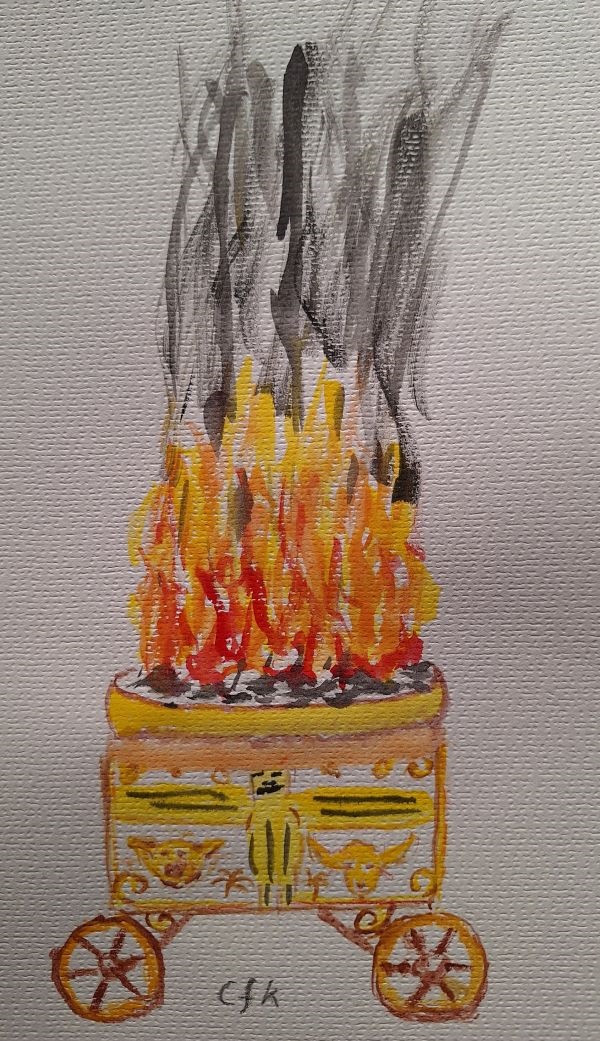
The bronze chariot, with images of cherubim on all four sides and a powerful fire from the great basin of fire, must have been an amazing sight. ”… Their wings were spread out above. Two wings of each one touched another (in the corners of the chariot cfk), and two covered their bodies.” [Ezekiel 1:11].
The chariot has rolled the few meters out of the temple's east gate to the big sacrificial altar: ”The glory of Yahweh appeared to all the people”. Perhaps the priests threw burning coals onto the altar, which was poured with oil.
Another possibility is that some kind of flamethrower was mounted on the back of the cherub chariot with the fire basin. It may have been a tube filled with oil with a large bellows at the end. When the fire chariot reached the altar, the priests pressed the bellows hard. The oil then sprayed out of the pipe and through the fire on the chariot, where it ignited. In a fountain of fire, the oil then landed on the sacrificial altar.
The Book of Kings tells that the ten temple chariots with water basins had lions and bulls and cherubim on the sides. But it is not mentioned here that one of the cherubim (or one of the cherubim faces) looked like a man and another looked like an eagle. The eagle cherub at the back of the chariot of fire may have been the oil sprayer "disguised" as an eagle, with its beak facing forward and raised above the chariot. And the human cherub at the front of the chariot was probably a priest or prophet, dressed as a cherub, who walked in front and steered the chariot.
The flickering of the fire in the basin of the chariot has breathed life into the shiny bronze figures. In Ezekiel's words: "As for the likeness of the living creatures, their appearance was like burning coals of fire, like the appearance of torches: the fire went up and down among the living creatures; and the fire was bright, and out of the fire went forth lightning. The living creatures ran and returned as the appearance of a flash of lightning." [Ezekiel 1:13-14]. And more: "Their feet were straight feet; and the sole of their feet was like the sole of a calf's foot; and they sparkled like burnished brass." [Ezekiel 1.7] – for everything were precisely made of brass or bronze.
When the ancestors experienced "the glory of Yahweh" on Mount Sinai, there was a loud sound of ram's horns. [2. Mos. 19.13-19]. Of course, because that's what happened at Solomon's temple when "the glory of Yahweh" appeared there. The priests have blown ram's horns to complete the magnificent scenery.
The bronze chariot with fire and cherubim and horn sound, and a huge plume of smoke was an awe-inspiring sight for the Israelite people who stood at a distance and watched it. ”All the children of Israel looked on, when the fire came down, and the glory of Yahweh was on the house; and they bowed themselves with their faces to the ground on the pavement, and worshiped, and gave thanks to Yahweh …” [2 Chronicle 7:3].
John the Evangelist writes: ”No one has seen God …” [John 1.18]. And according to Exodus, no one can see God and live. [Exodus 33.20]. But the Bible also says that Yahweh spoke to Moses: ”… face to face, as a man speaks to his friend.” [Exodus 33.11], and Exodus mentions that: ”… seventy of the elders of Israel went up. They saw the God of Israel …” [Exodus 24.9-11].
Somewhat surprisingly, it is said that: ”Three times in a year shall all your males appear before Yahweh your God in the place which he shall choose: in the feast of unleavened bread, and in the feast of weeks, and in the feast of tents …” [Deuteronomy 16.16. Also Exodus 23.17]. – These must have been the three times a year when Yahweh's chariot of fire rolled out of the temple and appeared to the people.
The Judean people saw their god in or as a great fire with a giant pillar of smoke rolling out of the temple. To them, Yahweh was without any shape. In many places in the Bible, the god Yahweh is described as fire and smoke. Because as it happened at the temple in the time of the kings, it must, of course, also have happened in the past:
At the Feast of Unleavened Bread, which is Passover (Pesach), Yahweh had led the Israelites out of Egypt: ”Yahweh went before them by day in a pillar of cloud, to lead them on their way, and by night in a pillar of fire, to give them light, that they might go by day and by night.” [Exodus 13.21].
At the Feast of Weeks, which is Pentecost (Shavuot), 50 days after Passover, Yahweh descended in fire and smoke on Mount Horeb (Mount Sinai): ”You came near and stood under the mountain; and the mountain burned with fire to the heart of the sky, with darkness, cloud, and thick darkness.” [Deuteronomy 4.11]. ”… you saw no kind of form on the day that Yahweh spoke to you in Horeb out of the midst of the fire.” [Deuteronomy 4.15]. ”For Yahweh your God is a devouring fire …” [Deuteronomy 4.24].
The Feast of Tents (Sukkot) falls one week after the Jewish New Year in the month of Ethanim (September-October). The First Book of Kings tells us that King Solomon dedicated the temple precisely: ”… in the month Ethanim, which is the seventh month.” [1 Kings 8.2]. And as we have seen, that is what happened. ”… the glory of Yahweh filled Yahweh's house. All the children of Israel looked on, when the fire came down, and the glory of Yahweh was on the house …” [Chronicles 7.2-3].
And each time it is a "first time", and thus, of course, something that happened every year as long as the temple stood.
Centuries later, the prophet John was given a vision of God’s throne surrounded by four cherubim, here simply called “living creatures.”: “… The first creature was like a lion, and the second creature like a calf, and the third creature had a face like a man, and the fourth was like a flying eagle. The four living creatures, each one of them having six wings …” [Revelation 4.7-8][3].
John’s cherubim had six wings, but not four faces each like Ezekiel’s cherubim. Ezekiel had firsthand experience of the temple, but John’s vision was also inspired by Ezekiel’s somewhat earlier prophet colleague Isaiah, who was presumably just as close to the events at the temple as Ezekiel.
Isaiah called the cherubim seraphim, which means “to burn.”[4] In the flickering firelight, the shiny bronze figures looked as if they were made of fire themselves. Isaiah saw Yahweh on a throne: “Above him stood the seraphim. Each one had six wings. With two he covered his face. With two he covered his feet. With two he flew.” [Isaiah 6.2]. “… and the house (the temple cfk) was filled with smoke.” [Isaiah 6.4]. Isaiah does not even mention the faces of the cherubim.
It may seem surprising that Ezekiel’s and Isaiah’s cherubim are nevertheless so different. But the bronze chariot may have changed appearance in the century that separated the prophets. And the prophets in the Bible often interpreted reality so that it fit their current situation.
It is easy for us to accuse the prophets and priests of fraud. But it has not been seen or understood that way at all. For heaven and earth were connected, and what happened in one place had to happen in the other. As on earth, so also in heaven. The priests and prophets acted for Yahweh, and symbolically what they did on earth was also what happened in heaven.
During the wandering in the wilderness, "the glory of Yahweh" did not, of course, exist in the form of a magnificent bronze chariot with cherubim. Here it is an expression of posterity's need to show that the ancestors had already experienced the same thing. Because whatever happened now had already happened to the ancestors.[5]
In ancient times, Israel and Judah were not the only ones to make use of spectacular “flamethrowers.” The ancient Greeks used a fantastic fire weapon that could blow cascades of fire over their enemies.
At the end of the 5th century BC (431-404 BC), the Peloponnesian War raged in Greece. Two confederations of city-states fought for power. These were the Peloponnesian confederation led by the city of Sparta, and the Delian confederation, led by Athens.
The historian Thucydides (ca. 460-400 BC) describes this war in detail. He writes that in the battle of Athens, the Peloponnesian confederation used a very special siege weapon. He carefully describes the technical setup:
”… an engine of the following description. They sawed in two and scooped out a great beam from end to end, and fitting it nicely together again like a pipe, hung by chains a cauldron at one extremity, with which communicated an iron tube projecting from the beam, which was itself in great part plated with iron. This they brought up from a distance upon carts to the part of the wall principally composed of vines and timber, and when it was near, inserted huge bellows into their end of the beam and blew with them. The blast passing closely confined into the cauldron, which was filled with lighted coals, sulphur and pitch, made a great blaze, and set fire to the wall, which soon became untenable for its defenders, who left it and fled; and in this way the fort was taken. Of the garrison some were killed and two hundred made prisoners; most of the rest got on board their ships and returned home …”[6]
In the Middle Ages (from the year 674 onwards) a notorious fire weapon, called "Greek fire", was used in the Christian Byzantine Empire. It was a flamethrower that was often used on ships to set other ships on fire.
Constantinople (now Istanbul) was saved several times by this weapon, which spewed a highly secret substance, probably consisting of oil, tar, resin and sulfur.[7] It was sprayed over the enemy, who discovered to their horror that the fire could not be extinguished with water.
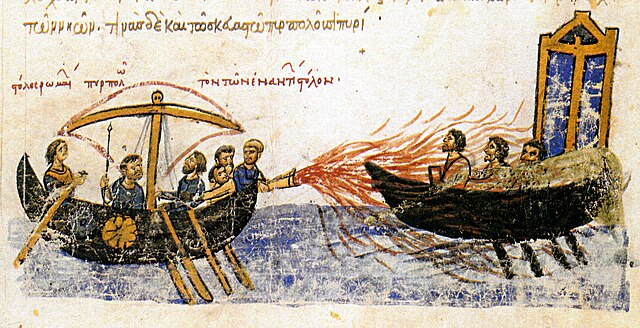 Here the similarity to the text from the Bible, ”there came forth fire from before Yahweh” is quite great. Because here too, it was burning oil that was sprayed out and set fire to whatever it hit.
Notes:
-
The Bible text is from World English Bible (2000).
- (↑) Nephthai
- (↑)The book ’The King Mystery. Yahweh and the Daughter of Zion.’ tells of the temple prophets.
- (↑)English Standard Version’ has ”an ox” instead of “a calf”.
- (↑)britannica.com
- (↑)Mircea Eliade: Cosmos and History. The Myth of the Eternal Return. Harper & Brothers (1959). Ch. 1.
- (↑) Thucydides: History of the Peloponnesian War, 4.100. Translated by Richard Crawley. https://en.wikisource.org Model of an early Greek flamethrower (Science Museum in Thessaloniki).
- (↑) Greek fire